Setting Up a CRM: What the First 30 Days Should Actually Look Like
Setting up a CRM takes an afternoon. Making one stick takes a month, and the difference between the two is where almost every small-business CRM project quietly dies. Nothing technical goes wrong: the import works, the fields are fine, and by week three everybody has gone back to their inbox because logging things felt like paperwork with no payoff.
This is a thirty-day plan built around that failure rather than around the software. It assumes one person is responsible, which is the first and most important condition.
Before day one: pick the tool and count your list
Two decisions, ten minutes, and they save a migration later.
Count the contacts you are about to import, because free tiers are capped on wildly different things. Read on 24 September 2026: Capsule's free plan states 250 contacts, EngageBay's states 250, Bigin's states 500 records including companies and deals, Zoho CRM's free edition states 3 users with no record cap on its pricing page, and HubSpot describes its free tools as free for up to 2 users.
Then count the people who need to log in. That single number eliminates most of the market; the free CRM comparison sets the five free plans against each other, and the ranked small-business CRM list prices the paid step out of each.
Week one: import, and resist everything else
The goal for week one is a populated CRM and nothing more. No automation, no custom modules, no reports.
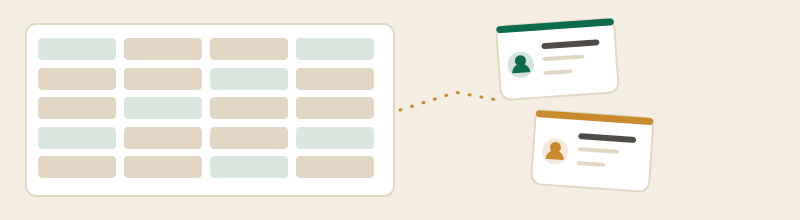
- Clean the list in the spreadsheet, before it goes anywhere. Deduplicate, split names, standardise company names, delete anybody you will never contact again.
- Import contacts and companies, not history. Old email threads almost never transfer usefully; keep the spreadsheet as an archive.
- Set an owner on every record. A record with no owner is a record nobody will ring back.
- Export once, immediately. It shows you exactly what you could take out again — the thing nobody checks until the day they need it. Note that Zoho CRM's free edition states data export up to ten times.
If the import takes more than an afternoon, the problem is the spreadsheet, not the CRM.
Week two: one pipeline, five stages, out loud
Now build the only structure that matters: the stages a piece of work passes through in your business. Five at most, named in the words your team already uses rather than the vendor's defaults. "Enquiry, quoted, chasing, won, lost" beats anything with the word "qualification" in it.
Agree the entry rule for each stage out loud, because a stage everybody defines differently is a report nobody can read. Then put every live piece of work on the board — only the live ones. A board that shows twelve real deals is more useful in week two than one that shows two hundred historical ones.
Vendors price pipelines, so check what you have: Capsule's free plan states 1 sales pipeline, Bigin's free plan states one pipeline against three team pipelines on Express at $7 per user per month billed yearly, and HubSpot's Starter tier states up to 15 total pipelines per account.
Week three: the habit, which is where it fails
This is the week the project dies, so plan it rather than hoping.
Pick one daily ritual and one weekly one. The daily ritual is five minutes at the end of the day logging what happened and setting next actions with dates. The weekly one is fifteen minutes going through anything with no next action against it.
Make the CRM the answer to a question somebody asks out loud. When a colleague asks where something stands, answer from the CRM in front of them rather than from memory. That is the moment other people start using it, and no amount of training substitutes for it.
Two things to leave switched off this week: automation and reports. Automating a process nobody follows yet builds a machine that produces mess faster, and a report on three weeks of partial data will be wrong in a way that discredits the whole exercise.
Week four: the first review, and only now automation
At the end of the month, run the three tests that tell you whether contact management is working: pick a customer at random and check the last thing that happened is written down; ask somebody else to find out what you owe a client without asking you; search a company name and count how many records come back. The contact management guide sets out the structure behind those tests.
If they pass, this is the right week for exactly one automation — usually a task created when a deal changes stage. One, chosen because it removes a recurring error rather than a recurring chore.
If they fail, do not add anything. Find out which of the three failed and fix the habit behind it. A CRM nobody updates is not a software problem and no tier upgrade will fix it.
When to start paying
Let a published cap tell you, not a salesperson. The honest triggers are a third person needing a login, a contact list passing the free ceiling, or an automation you have proved you need by doing it manually for a month.
Prices for the first paid rung, read on 24 September 2026: Bigin's Express is $7 per user per month billed yearly and $9 billed monthly; Zoho CRM's Standard is $14 billed annually and $20 billed monthly; Capsule's Starter is $18 on the annual term; EngageBay's Basic is $13.79 on the yearly term. Before you commit to an annual plan, check the monthly one — for a tool your team has used for four weeks, the premium for being able to leave is often worth paying.
CRM setup questions
How long does it take to set up a CRM?
What should I do first when setting up a CRM?
How many pipeline stages should a small business have?
When should I turn on CRM automation?
Comparing tools rather than reading about one? The best CRM for small business, ranked puts the seat prices in a single table, and the free CRM page does the same for the free tiers and their caps.