What Is a CRM? The Small-Business Answer, Without the Jargon
A CRM is one shared record of every person and company you sell to, and of everything that has passed between you: the calls, the emails, the quote you sent in March, the thing you promised to do on Thursday. The letters stand for customer relationship management, which is a phrase from a boardroom, and the working translation is shorter — it is the filing cabinet your business keeps instead of the one in somebody's head.
That is the whole idea. Everything a CRM vendor sells on top of it — email campaigns, pipelines, forecasts, AI summaries — is an extra floor built on that one foundation.
The three things every CRM does
Strip the category down and three capabilities are left, and any tool that has all three is a CRM whatever it calls itself.
- A record per person and company. Not a row in a list, but a page: contact details, the company they belong to, and every interaction attached underneath in date order.
- A next action with a date on it. The thing you owe somebody, visible to whoever is covering for you. This is the feature that actually earns the subscription.
- A stage for anything you are trying to win. A deal, an enquiry, a job — something that moves from "they asked" to "we quoted" to "they said yes or no", so you can see what is in flight without asking anyone.
Everything else is optional. A small business that has those three in one place and keeps them current has a working CRM, and a business with a beautiful CRM that nobody updates does not.
What a CRM is not
It is not a mailing list. Sending the same message to a thousand people is email marketing, and although several CRMs include it, the two jobs are different: a CRM remembers one relationship at a time.
It is not accounting. A CRM tracks the conversation that leads to an invoice, not the invoice itself, and the ones that promise both usually mean an integration rather than a ledger. That distinction is worth understanding before you buy, and what "CRM with invoicing" actually means pulls it apart.
It is not a help desk, though the boundary is genuinely blurry for businesses where selling and supporting are the same conversation. And it is not a project manager: a CRM cares about whether you won the work, not about who is doing which task on Tuesday.
What "customer relationship management" replaced
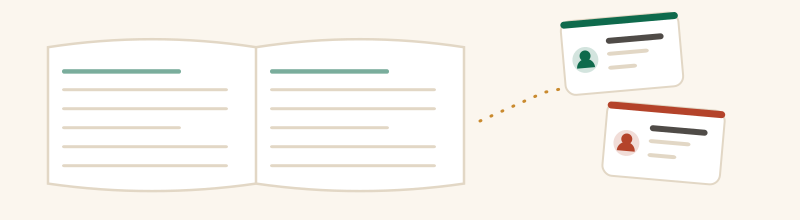
It helps to know what the category grew out of, because the shape of modern CRMs still shows it. The ancestor is the card index — a box of cards, one per customer, with a note of each visit written on the back. The first software versions in the 1980s and 1990s were contact managers that did exactly that and little more. Pipelines, automation and reporting arrived later, aimed at large sales teams with managers who needed to see the total.
That history is why so many CRMs feel overbuilt to a business of four people. You are being sold a tool designed to let a sales director supervise thirty representatives, when what you need is the card box, kept in one place, that reminds you to ring somebody back.
The moment a small business needs one
There is no contact count that triggers it. There are three moments, and most businesses meet at least one of them within a couple of years.
The first is the second person. As soon as somebody else needs to know what was said to a customer, the information has to leave one person's memory and inbox. The second is the dropped follow-up: the quote that went quiet because nobody owned the next step. The third is the returning customer nobody recognises — someone comes back after eight months and the history of the last job is spread across two inboxes and a phone.
If none of those has happened to you, you may not need a CRM yet, and there is no shame in that. The honest case for staying on a spreadsheet sets out exactly where the line is.
What a CRM costs a small business
Less than most people expect for the entry tiers, and the free versions are real. Read on 24 September 2026: Zoho CRM's free edition states three users, HubSpot's pricing page describes its free tools as free for up to two users, Capsule's free plan states a maximum of two users and 250 contacts, and Bigin's free plan states a single user and 500 records.
Paid entry plans for a small team sit between roughly $7 and $18 per seat per month. Bigin's Express is $7 per user per month billed yearly; Zoho CRM's Standard is $14 billed annually against $20 billed monthly; Capsule's Starter is $18 per user per month on the annual term. The expensive part of CRM is almost never the first plan — it is the tier three steps up, where per-seat prices multiply and one-time onboarding fees appear. The ranked list of small-business CRMs prices eight of them side by side with the billing term attached to each.
The vocabulary, translated
- Contact — a person. Company or account — the organisation they work for. Most CRMs link the two.
- Lead — someone who might buy but has not been qualified yet. Some CRMs keep leads separate from contacts, which is a common source of confusion in a small business where they are the same person.
- Deal or opportunity — a specific thing you are trying to win, with a value and a stage.
- Pipeline — the ordered list of stages a deal passes through. Most small businesses need one pipeline; vendors charge by how many you can have.
- Activity — a call, meeting, email or note attached to a record.
- Workflow or automation — a rule that does something when something else happens, such as creating a follow-up task when a deal changes stage.
- Record — the umbrella term, and the unit several vendors count for their limits. Bigin's free plan states 500 records, which is contacts, companies and deals together rather than contacts alone.
The question to ask instead of "which CRM is best"
Ask what will stop working first. Every CRM is generous at the start and charges at a boundary: a seat count, a contact ceiling, a record total, a pipeline limit, an automation allowance. The one that suits your business is the one whose boundary is furthest from the way you work — and if the answer turns out to be "none of them, yet", the free tiers are a fine place to find that out. The free CRM comparison lists each plan's cap as its own pricing page states it.
Common questions about CRMs
What does CRM stand for?
What is the difference between a CRM and a contact list?
Is a CRM the same as email marketing software?
How long does it take to set up a CRM?
Comparing tools rather than reading about one? The best CRM for small business, ranked puts the seat prices in a single table, and the free CRM page does the same for the free tiers and their caps.