Zoho CRM and Bigin Review: Two Tools, One Company, Different Jobs
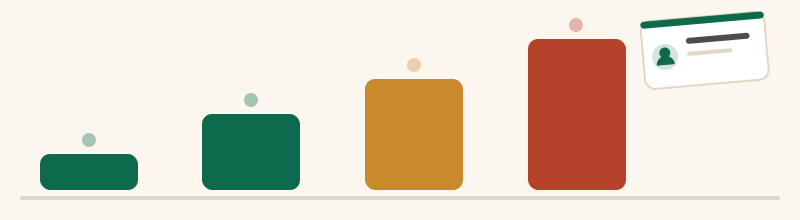
Zoho sells two CRMs to small businesses and they are not versions of each other. Zoho CRM is a full platform with modules, custom fields and an administration screen. Bigin is a pipeline tool with the platform deliberately removed. Choosing between them is not a budget decision first — it is a question about whether anybody in your business wants to configure software.
The free editions, side by side
Zoho CRM's free edition states three users, with contact management, follow-up reminders, workflow automation, up to ten custom email templates, tasks, meetings and calls, standard reports, mobile apps and 5,000 API calls a day. It also states data import and export, with export limited to ten times.
Bigin's free plan states a single user, 500 records and one pipeline, with three automations, a built-in phone, third-party phone integration, a standard dashboard, developer APIs and booking and appointment scheduling. The 500 records figure is the one to watch: it counts contacts, companies, products and activities together rather than contacts alone.
So the free comparison is straightforward. If more than one person needs to log in, Zoho CRM's free edition is the only one of the two that will do. If you are working alone, Bigin's free plan gives you a real pipeline where Zoho CRM's gives you a real platform.
The four editions, and what monthly billing adds
Zoho publishes both billing terms in its own pricing feed, which makes the cost of flexibility unusually easy to see. Read on 24 September 2026, per user per month: Standard is $14 billed annually and $20 billed monthly; Professional is $23 and $35; Enterprise is $40 and $50; Ultimate is $52 and $65.
The pattern is worth noticing. The monthly premium is about 43% at Standard and about 25% at Ultimate, so the smaller your plan, the more you pay for the right to leave at a month's notice. For a three-person business on Standard, that is the difference between $504 and $720 over a year.
Each bar runs to the monthly price; the dark part is the annual price. The gold tail is the premium Zoho charges for the freedom to leave at a month's notice.
per user per month, billed annuallybilled monthly
The smaller sibling, priced
Bigin's ladder is shorter and cheaper. Per user per month, read the same day: Express is $7 billed yearly and $9 billed monthly; Premier is $12 and $15; Bigin 360 is $18 and $21. Zoho advertises up to 35% off for going yearly on that page; the three published editions above actually work out between 14% and 22% cheaper on the yearly term, so take the banner as a ceiling rather than a rate. Bigin also offers a 15-day free trial with free onboarding.
What the money buys is capacity rather than a different product. Express adds three team pipelines, 50,000 records, email and WhatsApp Business integration, 30 automations and ten custom fields per module. Premier reaches five team pipelines, 100,000 records, 50 automations, 25 custom fields and 1,000 AI credits a month. Bigin 360 goes to 15 team pipelines, a million records and 3,000 AI credits a month.
Bigin's three paid editions on both terms, read from Zoho's own pricing feed on the same day as the table above.
per user per month, billed annuallybilled monthly
Which one a small business should open
Ask one question: does anybody here want to configure software? If the honest answer is no, open Bigin. Its whole design is a refusal to offer the knobs, and a business that will never build a custom module is better served by a tool that does not have one.
If the answer is yes — or if you can see modules, custom fields and multi-step automation being genuinely useful within a year — open Zoho CRM, because migrating from Bigin to Zoho CRM later is still a migration even inside one company. The three-user free edition gives you room to find out before paying.
The second question is seats. Bigin's free plan is single-user, so a two-person business that wants free has one option of the two.
The awkward parts
Two, and neither is a deal-breaker if you know about them.
The first is ownership. Zoho CRM gives a small business more settings than it needs, and unowned settings rot: duplicate fields, half-finished workflows, reports nobody reads. Nominate somebody, or choose the tool that cannot drift.
The second affects us rather than you, and we would rather say it than not. Zoho's referral programme requires the referred customer to sign up in the same data centre as the referrer, which means a reader in another region can subscribe through our link and Firstclient earns nothing. That is a reason to be suspicious of sites that place Zoho low for no stated reason, and it is a good example of why this site publishes who pays it.
Where they sit against the rest
Against HubSpot, Zoho is the cheaper ladder and the harder first hour; the trade is spelled out in the HubSpot CRM review. Against Capsule, Zoho CRM is more capable and less tidy. Against Pipedrive, Bigin is the cheaper pipeline and Pipedrive is the better one for a team that lives in a deal board all day.
For the full field with the billing terms attached, the best CRM for small business ranking puts all eight in one table, and the free CRM page compares the free tiers by the cap that ends them.
Who should open Zoho CRM or Bigin
Open Zoho CRM if you have two to ten people, want a free tier that genuinely holds a team, and have somebody willing to own the configuration. Open Bigin if you are one or two people who want a pipeline, a reminder and nothing else, and would rather spend the setup afternoon selling.
Avoid both if the thing you actually need is marketing email with a CRM attached, which is a different purchase — EngageBay's review covers that shape of tool.
Zoho CRM and Bigin questions
Is Zoho CRM free for small businesses?
What does a seat of Zoho CRM cost each month?
What is the difference between Zoho CRM and Bigin?
Can a small business outgrow Bigin?
Sponsored, nofollow. Subscribe at the far end of one and the vendor pays Firstclient a share of what you spend. The order above was fixed before any of that, and more than one tool on this site earns us nothing.
Comparing tools rather than reading about one? The best CRM for small business, ranked puts the seat prices in a single table, and the free CRM page does the same for the free tiers and their caps.